How to Make a Hand-Tied Flower Bouquet Like a Florist
Contents:
- What Makes a Hand-Tied Bouquet Different from Arranged Flowers
- What You’ll Need Before You Start
- Flowers and Foliage
- Tools
- The Spiral Stem Hand-Tied Bouquet Tutorial, Step by Step
- Step 1: Condition Your Flowers First
- Step 2: Start With a Focal Flower
- Step 3: Build Using the Spiral Technique
- Step 4: Tie and Trim
- Regional Flower Choices and Seasonal Considerations
- Practical Tips for a Longer-Lasting Bouquet
- Common Mistakes That Collapse a Bouquet
- Frequently Asked Questions
- How many stems do I need for a hand-tied bouquet?
- What is the best flower to start with for a hand-tied bouquet tutorial?
- How do you keep a hand-tied bouquet fresh?
- What’s the difference between a hand-tied bouquet and a posy?
- Can I use garden flowers instead of florist flowers for a hand-tied bouquet?
- Take Your Bouquet to the Next Level
A single hand-tied bouquet tutorial can save you $60 to $150 per arrangement — the average cost of a professionally made mixed bouquet from a US florist in 2026. But beyond the savings, there’s something deeply satisfying about building a bouquet from scratch, stem by stem, until it holds its own shape in your hand. If you’ve been growing cut flowers in your garden and wondering how to do them real justice, this is the skill that changes everything.
What Makes a Hand-Tied Bouquet Different from Arranged Flowers
Before getting into technique, it helps to understand what you’re actually making. A hand-tied bouquet is a self-supporting, freestanding arrangement where every stem is angled using a spiral technique. The stems lock together as you build, creating a natural grid that holds the flower heads in place — no foam, no wire, no vase mechanics needed.
This is different from a vase arrangement, where you place stems individually into water or floral foam and the container does the structural work. A hand-tied bouquet is its own structure. Once tied, you can stand it upright in a vase, wrap it for gifting, or lay it flat as a table centerpiece. The spiral stem technique is what separates a bouquet that holds together from a bunch that collapses the moment you let go.
What You’ll Need Before You Start
Flowers and Foliage
A well-balanced hand-tied bouquet typically uses three types of plant material: a focal flower (like garden roses, dahlias, or sunflowers), secondary flowers (like lisianthus, spray roses, or scabiosa), and filler and texture (like eucalyptus, astilbe, or grasses). Aim for a ratio of roughly 40% focal, 35% secondary, and 25% texture. For a medium bouquet — about 10 to 12 inches across — plan on 7 to 10 stems of your focal flower and 15 to 20 stems total.
Strip all foliage from the bottom two-thirds of every stem before you start. Leaves left below the tie point rot in water fast and create bacteria that shortens vase life by up to 50%.
Tools
- Floral snips or sharp bypass pruners — dull blades crush stems instead of cutting them cleanly
- Floral tape or natural twine — for the binding point
- A rubber band — useful for temporarily holding the bouquet while you tie
- A clean bucket of water — all conditioned stems should go straight back in water after cutting
The Spiral Stem Hand-Tied Bouquet Tutorial, Step by Step
Step 1: Condition Your Flowers First
Cut stems at a 45-degree angle and place them in cool water for at least 2 hours — ideally overnight. Roses and hydrangeas benefit from a full 12-hour conditioning period. This step is non-negotiable if you want the finished bouquet to last 5 to 7 days in a vase. Flowers pulled straight from the garden and immediately arranged will wilt within hours.
Step 2: Start With a Focal Flower
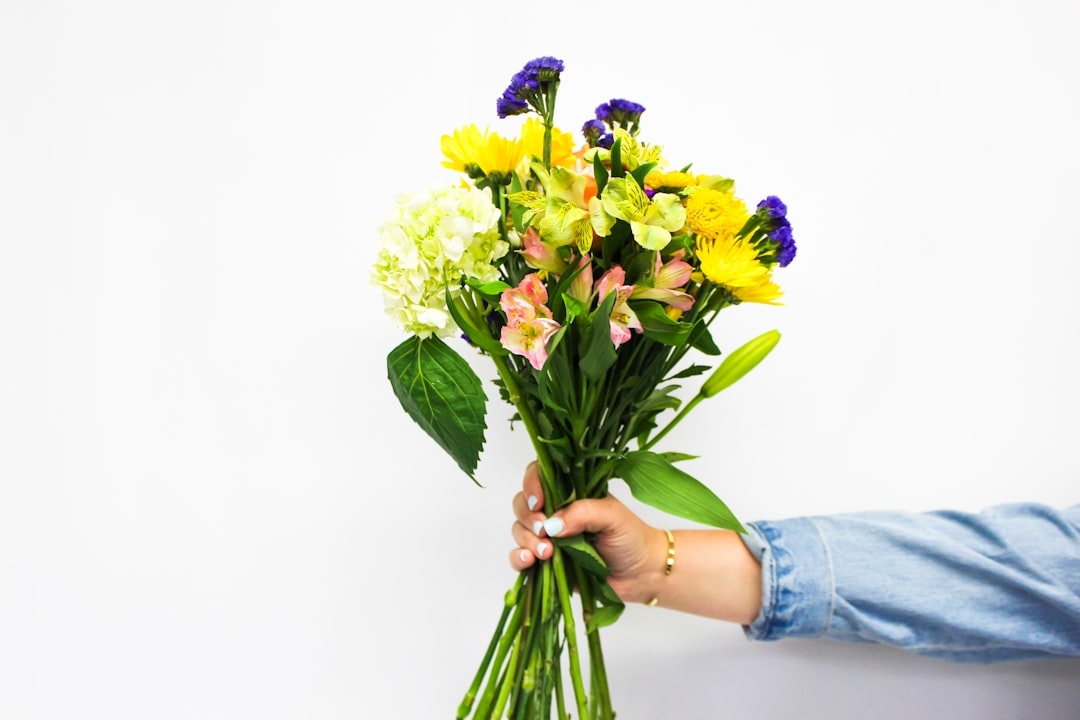
Hold your first stem loosely in your non-dominant hand, about two-thirds of the way down. This grip point will become your binding point — keep it consistent throughout. Your first stem is vertical. Every stem after it angles slightly, always in the same rotational direction (either always clockwise or always counterclockwise — pick one and commit).
Step 3: Build Using the Spiral Technique
Add each new stem at roughly a 45-degree angle across the stems already in your hand, rotating the bouquet slightly toward you with each addition. You’ll feel the stems start to lock against each other — that’s the spiral working. Add your secondary flowers and texture stems in between focal flowers so no single flower type clusters together. Step back every few stems to check for gaps and height variation. Aim for a domed profile: the center flowers sit slightly higher than the outer ring.
Step 4: Tie and Trim
Once you’re satisfied with the shape, use your rubber band to temporarily secure the bouquet at the binding point. Wrap floral twine or tape tightly around the stems at least three times and knot firmly. Then cut all the stems to a uniform length — about 10 to 12 inches is standard for a medium bouquet. Cut straight across (not at an angle) for the bottom, so the bouquet stands level in a vase.
🌸 What the Pros Know: Professional florists always test the bouquet’s balance before tying by releasing their grip slightly. If the spiral is correct, the bouquet will hold its shape for 2 to 3 seconds without support. If it collapses, the stems aren’t locked — go back and re-angle. This is the single fastest way to diagnose a loose spiral before it’s too late to fix.
Regional Flower Choices and Seasonal Considerations
Where you garden in the US shapes what’s realistically available for a hand-tied bouquet. In the Northeast, peak cutting season runs June through September, and garden roses, peonies, and zinnias are workhorses for summer bouquets. In the South, you have a longer window — February through November in many zones — but summer heat means you’ll be cutting early in the morning and conditioning in a cool space immediately. Dahlias and celosias thrive here. On the West Coast, especially in California (USDA Zones 9–10), ranunculus and anemones bloom in late winter and spring, giving bouquet-makers a head start that Northeast gardeners simply don’t have. Knowing your regional window helps you plan what to grow specifically for cutting rather than just display.
Practical Tips for a Longer-Lasting Bouquet
- Re-cut stems at a 45-degree angle immediately before placing the finished bouquet in a vase — even 30 minutes of air exposure seals the cut end.
- Change the water every 2 days. Bacterial buildup is the primary cause of early wilting, not dehydration.
- Keep bouquets away from fruit. Ripening fruit emits ethylene gas, which accelerates flower aging. A bowl of bananas on the counter can shorten vase life by 2 to 3 days.
- Use floral preservative (the small packet that comes with florist bouquets) or make your own: 1 tablespoon sugar, 1 tablespoon white vinegar, and ½ teaspoon bleach per quart of water.
- Avoid direct sun and heat vents. The ideal display temperature is 65°F to 72°F.
Common Mistakes That Collapse a Bouquet
The most frequent error in a first hand-tied bouquet is inconsistent spiral direction — adding some stems clockwise and others counterclockwise. It looks fine visually until you let go, and then the whole thing fans apart. Commit to one direction from stem one.
The second common mistake is holding the bouquet too tightly. A death grip tires your hand and prevents you from feeling whether the stems are actually locking. Hold firmly but not rigidly — you should be able to rotate the bouquet smoothly with each new stem.
Finally, don’t over-stuff. A 20-stem bouquet with good structure always looks better than a 35-stem bouquet with poor spiral geometry. Negative space between flower heads gives each bloom room to show its shape.
Frequently Asked Questions
How many stems do I need for a hand-tied bouquet?
A small hand-tied bouquet typically uses 12 to 15 stems; a medium bouquet uses 20 to 25 stems; and a large, full bridal-style bouquet may use 35 to 50 stems. For a beginner, start with 15 to 18 stems — enough to practice the spiral without becoming overwhelming.
What is the best flower to start with for a hand-tied bouquet tutorial?
Sunflowers and garden roses are ideal for beginners. Their sturdy, straight stems are easy to angle and lock into a spiral, and their large heads make it easy to see the dome shape forming. Avoid delicate flowers like sweet peas or lily of the valley until you’re comfortable with the technique.
How do you keep a hand-tied bouquet fresh?
Recut the stems at a 45-degree angle, place in clean water with floral preservative, change the water every 2 days, and keep the bouquet away from direct sunlight, heat, and ripening fruit. Properly conditioned flowers in a hand-tied bouquet last 5 to 8 days on average.
What’s the difference between a hand-tied bouquet and a posy?
A posy is a small, compact, round bouquet — typically under 6 inches in diameter — often wrapped in paper or ribbon. A hand-tied bouquet is a broader term for any bouquet assembled using the spiral stem technique, regardless of size. All posies are hand-tied, but not all hand-tied bouquets are posies.
Can I use garden flowers instead of florist flowers for a hand-tied bouquet?
Yes — garden flowers work beautifully, and many professional florists prefer them for their character and scent. The key difference is conditioning: garden flowers need a longer water soak (6 to 12 hours) than shop-bought flowers that have already been conditioned. Cut in the early morning when stems are most hydrated, strip foliage immediately, and place in cool water before assembling.
Take Your Bouquet to the Next Level
Once you’ve made three or four hand-tied bouquets, the spiral becomes muscle memory — you’ll stop thinking about it and start focusing on color, texture, and storytelling through your flower choices. That’s when bouquet-making shifts from technique to art. Consider keeping a cutting journal: note which varieties held up best, which pairings surprised you, and what you’d plant more of next season specifically for cutting. Your garden and your bouquets will evolve together, season by season, in a way that no store-bought arrangement ever could.